No more prompt ping-pong: Agent Mode
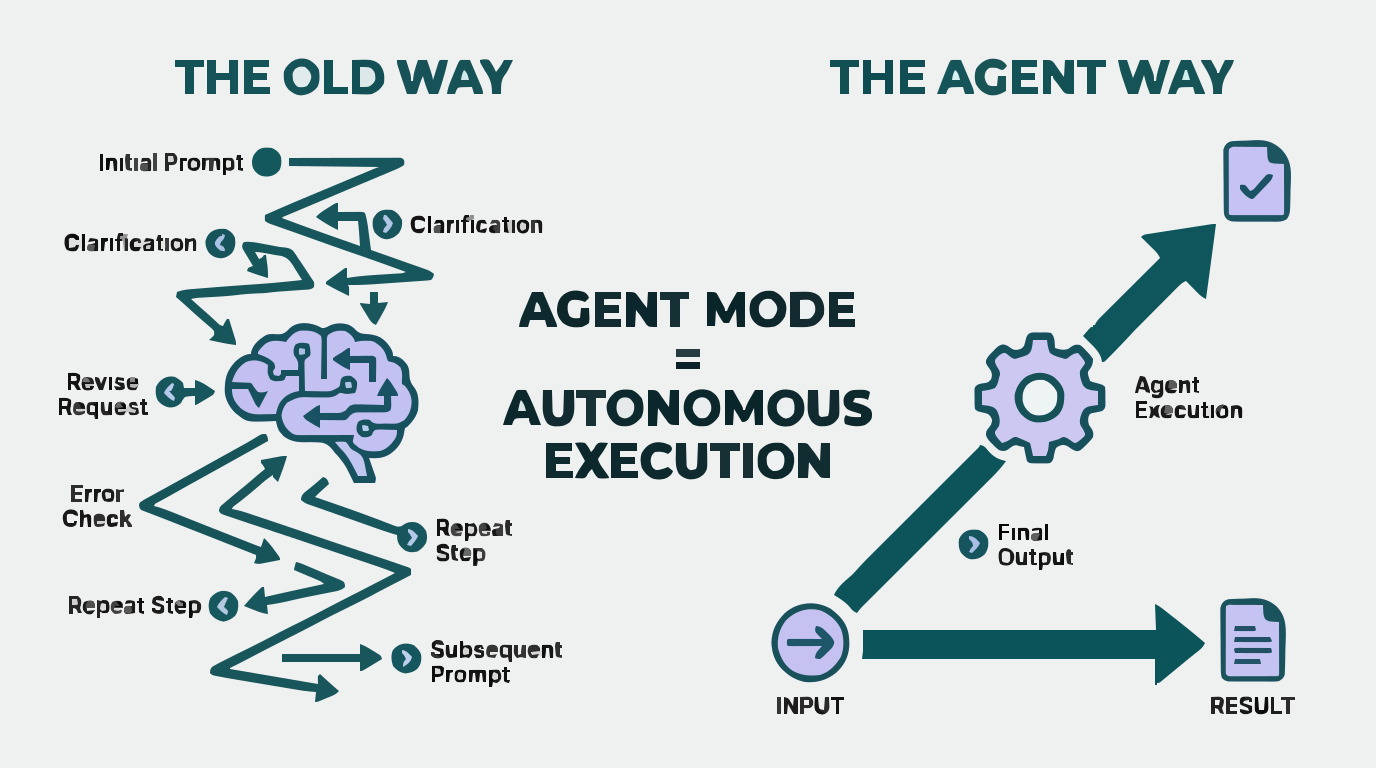
Imagine you're explaining a task to someone — and then you have to dictate each individual step to them. Step by step. Wait for feedback. Correct the course. Start over. This is chat AI, as most teams use it today. Productive? Yes, a little. But far from what could actually be possible.
McKinsey estimates that 57% of all working hours are already automatable today (McKinsey Global Institute, November 2025). The catch: Most companies are not harnessing this potential because they still treat AI like a better search field — as a tool that one operates question by question, rather than as part of a real workflow.
Agent Mode is the step that changes that.
1. The Problem with Chat-based AI
Chat AI is brilliant for clearly defined tasks. You ask, it answers. You refine, it adjusts. This works well for composing an email, summarizing a meeting, or explaining a concept.
The problem begins when the task becomes more complex. When you don’t want to write an email but rather develop an entire campaign — with research, target audience analysis, drafting, feedback loops, and finalization. Then you become the human middleware. You provide input, take output, evaluate, correct, and give input again. The prompt ping-pong begins.
And that is exactly why expectation and reality are so far apart: 79% of companies are already employing AI agents, but 66% report measurable productivity increases — while at the same time, 80% of companies still do not see any material yield effect despite AI adoption (McKinsey State of AI, 2025; Gartner/Forrester, 2026). Many teams have introduced AI but have not changed their way of working. They type more prompts instead of genuinely delegating tasks.
2. How Agent Mode Works Differently
The difference between chat AI and Agent Mode is not incremental — it is conceptual.
Chat AI waits for your next prompt. An agent acts. It gets a goal, not a command. It can use tools, plan intermediate steps, check results, and correct the course as needed — without you having to intervene after each step.
Specifically, this means: An agent can initiate a web search, evaluate relevant sources, create a structured summary from that, integrate it into an existing document, and notify you at the end with the finished result. You have handed over a task. The rest happens without you.
According to Automatic.co, agentic workflows deliver 3 to 5 times higher productivity gains than classic chat AI (Automatic.co Benchmark Report, January 2026). The reason is simple: Chat AI accelerates individual steps. Agents eliminate whole intermediate stages.
That doesn’t mean that agents function without structure. They need clear goals, meaningful boundaries, and, depending on the task, a human as a control instance at specific decision points. But the basic logic shifts: You define the outcome, not the path to it.
3. Before and After: A Concrete Example
Let's take a realistic task from the everyday marketing world: the monthly content evaluation. A marketing team wants to know which blog posts performed the strongest in the last month, why this is the case, and which topics would make sense for the next month.
Without Agent Mode, it looks something like this:
You open the analytics tool, export the data, pull it into a spreadsheet, filter for relevant metrics, transfer the most interesting posts into a document, ask ChatGPT for possible insights, get generic answers, refine, copy parts of that into a presentation, and write the rest yourself. Time required: two to three hours.
With Agent Mode:
You set the goal: "Analyze the blog performance of last month, identify the top 5 posts by engagement, and derive three topic suggestions for April." The agent accesses the analytics API, evaluates the data, compares patterns, formulates insights, and returns a structured briefing to you. Time required: you confirm the result in ten minutes.
The difference lies not just in the time. It lies in what you can do with the time gained — namely, the things that truly require human judgment.
4. What Agents Cannot Do — and Why It Matters
75% of marketers use AI — but 84% still run generic campaigns (Salesforce State of Marketing, 10th Edition, 2026). This is not an argument against AI. It is an argument against unclear goals.
Agents are not miracle solutions. They are only as good as the goal you give them, and as reliable as the data and tools they have access to. A poorly formulated goal produces well-executed nonsense.
Concrete boundaries that every team should know:
Agents need context. If the task requires implicit knowledge — company culture, internal politics, customer relationships — people need to bring that in. An agent does not know that your main customer is currently undergoing a restructuring unless you tell them.
Agents must be controlled. Especially for tasks with external impacts — sending emails, publishing documents, changing data — there should always be a human approval step included. Autonomy does not mean unaccountability.
Agents do not replace judgment. They can generate options, evaluate data, and create decision bases. The decision itself remains with humans — at least wherever consequences count.
Those who understand this work more efficiently with agents. Those who ignore it risk that a lot of automation produces little value.
5. The Real Step: From Reaction to Delegation
AI has long been a reactive tool. You ask, it answers. You prompt, it generates. This has increased productivity — but has not changed the fundamental structure of work.
Agent Mode shifts this structure. Not dramatically, not overnight. But noticeably: Tasks become goals. Processes become workflows. And your attention — already the scarcest resource in any team — is freed up for the things that truly require it.
The term "autonomous workflows" sounds like future talk, but it is already a lived practice for growing marketing teams. The question is no longer whether AI agents are sensible, but where in your own process to start using them.
A good starting point: identify a task that regularly costs time, is clearly definable, and for which you can easily verify the outcome. Not the most complex task, not the strategically most important — but one that simply costs you time without really giving you anything in return.
That’s where you start. The rest is handled by the agents.
For those wondering how such workflows can be represented on a website — that is, when the "agent" is not running in the background but interacts directly with visitors — branchly offers a possible starting point for that.