Authentic social posts with AI
AI writes social posts in seconds. That sounds like a good thing until you look at the feeds of your target audience.
56% of consumers regularly encounter so-called "AI Slop" in their feeds. As a result, 50% of Gen Z have already unfollowed accounts. (Sprout Social Q1 2026 Pulse Survey) The problem is not the AI. The problem is how most teams use it: on autopilot, without human correction, without real perspective behind it.
The way out is Human in the Loop. Not as a buzzword, but as a concrete process.
AI content erodes the trust of your followers
The discomfort with AI content is now measurable. 88% of people say AI-generated videos have fundamentally undermined their trust in social media news. (Sprout Social Q1 2026) This is not just about deepfakes or political misinformation. It also concerns brand content that feels like it has been churned out from a template.
What annoys consumers the most is remarkably clear: The most common behavior that consumers resent brands for is posting AI content without labeling it. (Sprout Social Q1 2026) At the same time, consumers cite human-generated content as their number one priority in 2026. (Sprout Social 2026)
This poses a real dilemma for marketing teams. The use of AI among social media marketers has increased by almost 180% since 2023. (Hootsuite 2025) Those who ignore AI lose the productivity advantage. Those who use AI blindly lose trust. Somewhere in between lies the answer.
Why full automation fails
The fault is not in the model. GPT-4, Claude, Gemini, they all can generate grammatically correct, structurally clean text. The problem is what they lack: your experience, your opinion, the specific conversation with a customer from last week.
When you tell an AI, "Write me a LinkedIn post about content marketing," you get a post about content marketing. What you don’t get is the one observation that truly shows something new to your followers. That only emerges when a human takes the draft and shapes it with what they really know.
Fully automated content lands, at best, in the middle ground. Average. Not wrong, but also not remarkable. And on a platform where your followers see hundreds of posts daily, "not wrong" is no longer a quality characteristic.
Additionally, there is a practical problem: When ten brands feed the same AI with similar prompts, similar posts are created. The same structure, similar phrasings, comparable statements. Your brand then sounds like all the others, which is the exact opposite of what social media is supposed to accomplish.
The Human-in-the-Loop process: Step by step
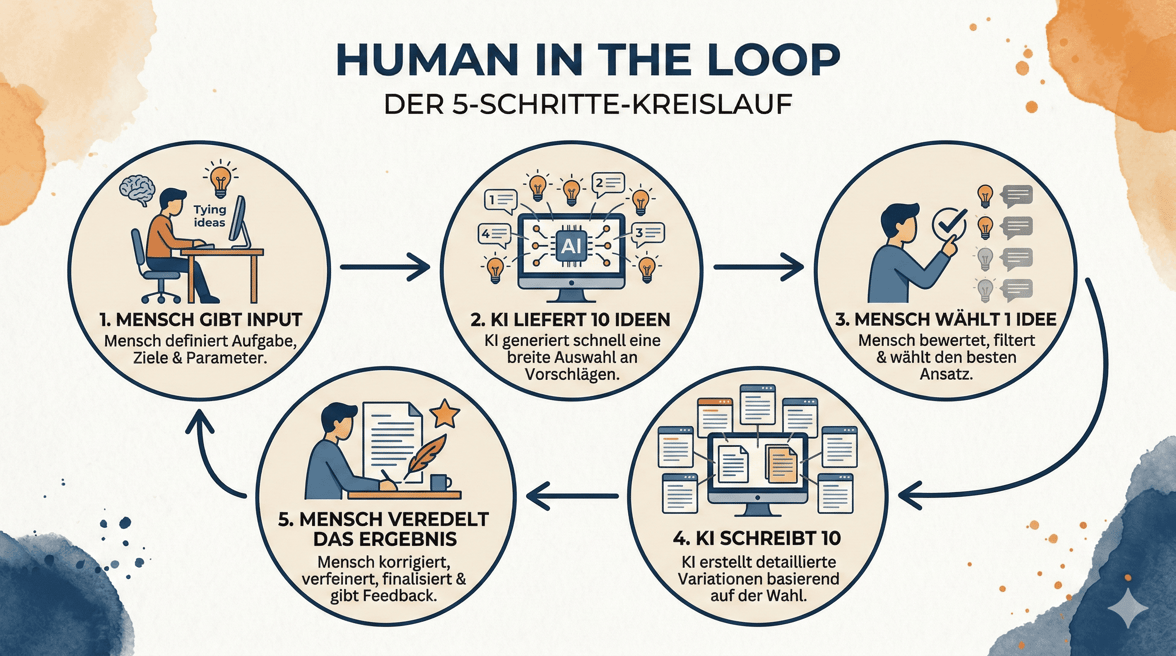
The approach behind Human in the Loop is simple: The AI handles the mechanical steps; you take on the content responsibility. The result is neither pure AI output nor a post that you have completely written by hand. It is a collaboration where everyone does what they do best.
Here’s what the process looks like in practice:
1. Provide input, don’t delegate tasks.
Don’t start with "Write me a post." Start with a specific observation, a number, a question from a customer conversation. The AI should turn this raw material into a draft, not decide on its own what to write about.
2. Read the draft critically.
Read the draft as someone who doesn’t care about the AI. Does it sound like you? Would you say it that way? Is the statement actually correct? You should briefly check specific numbers and claims before they go live.
3. Incorporate your own voice.
A sentence that can only come from you. A personal assessment. Something that does not come from a training dataset because it reflects your experience. That’s the sentence your followers will come back for.
4. Adjust the format.
AI drafts tend to have long paragraphs and formal structures. For LinkedIn or Instagram, you often need the opposite: short lines, a clear first sentence, a concrete conclusion. Format it yourself.
5. Optionally label.
If you used AI in creation, consider whether a brief note for your community fits. Not every post needs this. But transparency will positively impact trust in the long run.
72% of marketers report that AI-powered posts perform better than purely manually created ones. (HubSpot Social Media Trends 2025) The reason for this is likely not the AI alone, but the combination: faster output that has still been reviewed and enriched by a human.
The 10-Minute Post: A realistic timeframe
"AI saves time" is a phrase you read everywhere. Specifically, the time savings look like this:
An average LinkedIn post takes about 25 to 40 minutes without AI: choosing a topic, sorting thoughts, writing, revising, formatting. With a Human-in-the-Loop process, it spreads out differently:
2 minutes: Formulate core input (observation, number, thesis)
1 minute: Enter prompt, generate draft
4 minutes: Read draft, critically review, incorporate your voice
2 minutes: Revise format, adjust length
1 minute: Final check, hashtags, prepare for publication
10 minutes. For a post that still sounds like you.
83% of marketers say AI helps them create significantly more content. (Hootsuite Social Trends 2025) That’s true, but the critical point is what happens with this gained time. Teams that invest it in more quantity end up with AI Slop. Teams that use it to curate each individual post more carefully build real reach.
The difference between a mediocre AI post and a good one often lies in these 4 minutes of revision time. That’s not a big effort. It’s the decision of whether you produce content or communicate something.
Transparency as the new standard
Whether you need to label AI depends on the platform, context, and industry. The legal situation is currently evolving. But what is already becoming clear is that transparency will become a competitive advantage.
Brands that clearly communicate how and where they use AI build a different relationship with their community than brands that hide or conceal it. This applies not only to social media but is particularly visible there because the line between human and machine is often so distinctly felt.
Concretely, this means: You do not have to label every post with a disclaimer. But you should have a clear stance on when to label and when not to. And if you do, then briefly and directly. "Created with AI support" is enough. No one reads long explanations, and over-apologizing comes across as insecure.
The goal is not to apologize for using AI. The goal is to give your community the trust that behind the content, there is a human who has put thought into it. That human is you. The AI has helped. That’s not a weakness; it’s a modern production process.
The difference between good AI-supported content and AI Slop is ultimately the same as the difference between good and bad writing: Do you have something to say, and do you say it clearly? If so, it doesn’t matter which tool you used.