AI in Tourism: What Guests Really Ask

A guest sits in their hotel room and wonders: Is the restaurant open today? They don't walk to the front desk. They don't ask at the door. They open the hotel's website and ask their question in the chat. Florian Roth, junior manager at Hotel-Restaurant Spechtshaardt in the Spessart, learned exactly that when he reviewed his website chat analytics for the first time: "These are also hotel guests who are already in-house, who sometimes don't talk to us at all, but use the chat on our homepage instead" (branchly podcast Branch Out, November 2026).
This observation sums up why AI in tourism is not just a trend topic, but a fundamental shift: guests arrive with complete questions, not navigation clicks. The website that answers these questions in seconds wins. The website that doesn't loses the guest to the front desk, the phone, or the booking platform that responds immediately.
Guests ask differently today
Two years ago, visitors clicked through a tourism website: menu, subcategories, FAQ page. Today, they type in their question just as they would speak it: "Is the vacation apartment in Carolinensiel available in May and are dogs allowed?" 56 percent of leisure travelers have already used AI for at least one trip (Phocuswright, March 2026; US market, European trend similar). The expectation for an answer is correspondingly high: immediate, accurate, and in their own language.
For destinations and businesses, this means: the question is the most direct way to understand the guest. Not click paths in Analytics, not post-stay surveys, but the fully formulated question before booking. Florian Roth sees exactly this in his analytics: those who gather information via chat are often potential bookers (Branch Out, November 2026). First ask, then book.
Real questions from the chat: What guests want to know
Recurring question patterns can be derived directly from the conversation data of tourism clients. An excerpt from practice:
- Opening hours and availability: Restaurant, front desk, tourist information center. Notably, questions also come from guests who are already on site, from their room or from the hiking trail.
- Detailed pricing: Admission prices for facilities are among the most frequent questions for a destination. For one client, the same admission price was asked five times in short succession, even though the information was on the website—just not where guests were looking (branchly podcast with TANO, October 2026). That is a placement gap, not a content problem.
- Traveling with dogs: One of the most frequently asked questions in tourism, yet scattered across most websites only in fragments.
- Seasonal and specific topics: Do you need a reservation for the ferry? What is there to do on New Year's Eve with a dog? Parking in peak season? This is precisely where visits are decided because the answers are time-critical.
The common denominator: these are high-purchase-intent questions. Anyone asking about dogs, pricing, and opening hours is making concrete plans. And the following hour often decides whether they book or bounce.
From question to content: The knowledge gap workflow
The most valuable moment in AI operations is not the answered question, but the unanswered one. "In October, we were asked 20 times whether the destination is suitable for New Year's Eve with a dog. There was nothing about it on the website" (branchly client, anonymized, 2026). The chat answered cleanly: I can't find anything about that. And precisely because of that, the question wasn't lost, but documented as a knowledge gap.
This creates the most productive workflow that marketing teams in tourism have today:
- Automatically capture knowledge gaps. Every unanswered question lands in the analytics, sorted by frequency.
- Decide: new page or update knowledge base. Recurring topics with high demand deserve their own landing page, such as "Vacation with dogs". Individual questions are resolved by adding information to the knowledge base.
- Content from demand rather than gut feeling. For one North Sea client, over 20 new pages were created this way—each based on a verified cluster of questions, none of them decided in an editorial meeting (branchly case reference, 2026).
Eva Forkel, Digitalization Manager at Tourismus Agentur Nordsee, describes the result like this: "Maybe it makes sense to build a landing page for that. Maybe it makes sense to build a campaign around it if that's the trending topic right now" (branchly podcast, October 2026). Question data turns into prioritization, and prioritization turns into content with guaranteed demand.
Multilingualism and accessibility without an extra project
Managing tourism websites across 30+ countries of origin: in practice, guest communication is either multilingual or it doesn't happen at all. Traditional chatbots fail here fundamentally because every language needs to be maintained. The previous rule at Regensburg Tourismus was: no colleague at the tourist information center speaks six languages. Today, the AI agent responds in over 101 languages from the very same knowledge base, including accessibility in plain language (branchly Case Study Regensburg Tourismus, 2026).
This doesn't just affect distant markets: digital accessibility is mandatory for public destinations under the Accessibility Strengthening Act (BFSG), and for any business, it simply opens up an additional audience. AI interfaces that automatically respond in plain language meet both requirements without any separate setup.
Reliability: Why answers from your own knowledge base win
The most visible fear of AI in tourism is fabricated answers, and it isn't unfounded. The best-known example: if you ask a generic AI model about the Regensburg zoo, experience shows it readily provides an address near a shopping center. There is no zoo in Regensburg (branchly Case Study Regensburg Tourismus, 2026).
That is precisely why the AI interfaces of leading destinations do not rely on a model's world knowledge, but on their own curated knowledge base: website content, event calendars, and connected data sources. Every answer cites its source. Where no information is available, the AI states it, making that exact gap visible instead of inventing something.
A side effect that hardly anyone plans for, but everyone appreciates: staff at the tourist information center use the chat themselves as an internal reference tool whenever an answer isn't immediately at hand (branchly podcast with TANO, October 2026). The knowledge base becomes a work tool for the team.
How destinations benefit
Three proven impacts from client projects:
- Relief: 53 percent fewer routine inquiries for the tourist information team at Regensburg Tourismus (branchly Case Study, 2026). The team works on cases where humans are irreplaceable: personalized advice, special cases, and on-site guests.
- Availability outside opening hours: The phone AI at Regensburg Tourismus successfully resolves around 200 calls per month, especially in the evenings, on weekends, and on public holidays, complete with an automatic summary for the team (branchly Case Study, 2026).
- Better marketing decisions: Seeing which questions actually come in also changes how print and campaigns are positioned. Carolin Molski from Regensburg Tourismus describes it like this: "Maybe that's not what we need to focus on at all." Inquiry data provides the priorities, not the annual planning meeting (branchly podcast, June 2026).
Added to this is the perspective concisely expressed by Eva Forkel from Tourismus Agentur Nordsee: "We're no longer just talking about a pure chatbot; this really is an AI marketing platform now" (branchly podcast, October 2026). The chat answers questions, yes. But the same data tells marketing which topics are currently in demand in the destination, what content is missing, and where the guest clicks next. Cookieless, straight from first-party conversations.
Frequently Asked Questions
What does AI cost for a destination or hotel business?
An AI layer like branchly starts at €1,000 per month plus a one-time setup fee. The scope is based on active sessions; voice is added based on minutes.
Is it worth it for small businesses, too?
A family-run business in the Spessart operates the chat without its own IT team and gains two main things: answers in seconds for guests, and insights that no one else can provide. The question isn't about size, but whether inquiries are arriving that currently go unanswered.
What about data protection?
GDPR-compliant solutions with EU hosting are the standard expectation in tourism, especially for public bodies. Look for EU data storage, traceable AI answers, and accessibility in accordance with the BFSG and WCAG 2.1 AA.
Does AI replace the tourist information center?
No, it relieves it. Routine questions are resolved automatically, giving the team more time for on-site guests. In Regensburg, personal consultation remains the core; AI merely handles the routine volume.
What should come first in a website relaunch?
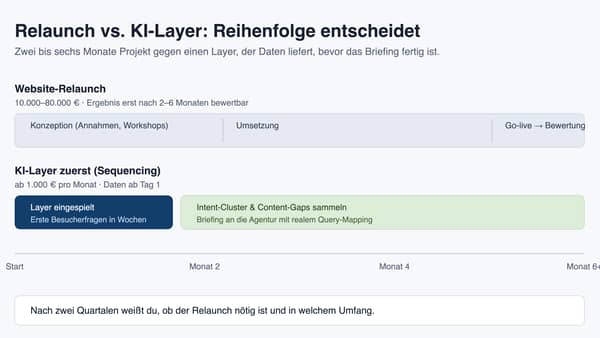
First data, then structure. If you collect the questions guests are really asking for a year prior to the relaunch, you build the new website around proven needs rather than assumptions.
Summary
AI in tourism isn't decided by technology, but by guest questions. Seeing the questions reveals which content is missing, which topics deserve campaigns, and where travel planning is truly heading. Examples from four customer projects show the pattern: knowledge gaps become landing pages, unanswered questions become new pages, and inquiry data leads to better marketing decisions.
The rest is simply the result: 53 percent fewer routine inquiries, around 200 calls per month after hours, over 101 languages from a single source, and answers with source citations instead of hallucinations. Destinations setting this up today are gathering the exact data that others will be waiting for during their next relaunch.
Related Topics